
Why Tarangire Belongs on Every Tanzania Safari
April, 2026
Tanzania has no shortage of famous names. The Serengeti. The Ngorongoro Crater. Kilimanjaro. They carry the weight of decades of wildlife documentary and traveller folklore, and rightly so. But there is one park that keeps slipping past the headlines, quietly accumulating devoted admirers, and delivering some of the most memorable safaris on the continent.
Tarangire National Park is not Tanzania’s best-known destination. It may well be its best.
A landscape unlike any other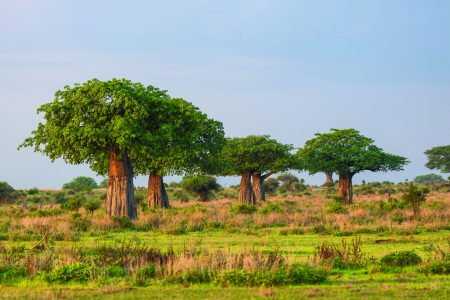
Drive into Tarangire, and you’ll know immediately that this is somewhere different. The landscape announces itself: vast and ancient, scattered with baobab trees so broad and gnarled they look less like trees and more like something sculpted by centuries of wind and patience. Known informally as the Baobab Capital of the World, the park holds a remarkable concentration of these iconic trees, their swollen trunks rising from red-earthed plains and casting long shadows across the savannah below.
The park covers approximately 2,850 square kilometres, its terrain spanning granitic ridges, river valleys, swamps and a varied mix of acacia and combretum woodland. Running through it all is the Tarangire River, the lifeblood of the ecosystem. During the dry months, when the surrounding land bakes and cracks, the river becomes the single most important feature in the landscape — and everything that moves in Tarangire eventually moves towards it.
The dry season spectacle
From June through to November, thousands of animals concentrate in Tarangire National Park from the surrounding dispersal areas, drawn by the river and the Silale Swamp – a seasonal wetland that releases water slowly through the dry months, sustaining life long after the rains have passed. The result is one of East Africa’s most impressive wildlife gatherings and one that receives far less attention than it deserves.
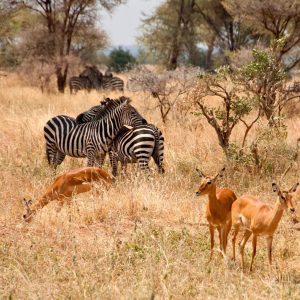
Among the animals that pour in are buffalo, elands, gazelles, hartebeests, impalas, wildebeest and zebras, all arriving in their thousands. Predators — lions, leopards, cheetahs, hyenas and wild dogs — follow the abundance. Over 700 resident lions make for frequent sightings, and their tree-climbing behaviour adds an element of surprise to every game drive. You learn quickly not to assume a motionless acacia holds nothing of interest.
The park also draws rarer species that few other destinations in northern Tanzania can offer, including the fringe-eared oryx and the gerenuk – a long-necked antelope that stands on its hind legs to browse the higher branches of thornbush. Both are special sightings. Neither is guaranteed anywhere else on the northern circuit.
 The elephants of Tarangire
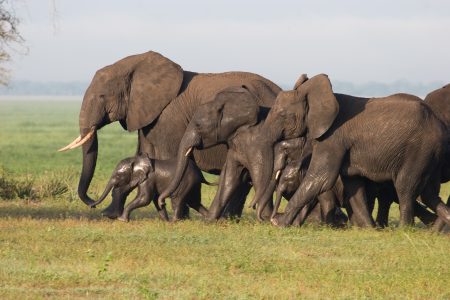
If the park has a signature species, it is undeniably the elephant. Tarangire is estimated to be home to around 2,500 elephants, with numbers increasing by approximately 6% per year and some herds reaching 600 individuals. To sit and watch a herd of this scale moving through the baobab landscape — matriarchs leading, calves tucking in close, old bulls moving alone at the edges — is to witness something that feels elemental. There is nothing hurried or performative about it. This is simply life as it has always been lived here.
The elephants of Tarangire are year-round residents. Even as other species migrate out when the rains return, the elephants remain, a constant and remarkable presence throughout all seasons.
A birder’s paradise, any time of year
Tanzania has excellent birdlife throughout its national parks, but Tarangire is in a category of its own. With over 550 recorded species, the park draws birdwatching enthusiasts from around the world, its swamp environments supporting some of the most diverse breeding bird communities on the planet.
The dry season brings concentrations of large birds – ostriches, Kori bustards, secretary birds and saddle-billed storks among them – to the area. Yellow-collared lovebirds, lilac-breasted rollers, sacred ibis and colourful kingfishers add vivid brushstrokes of colour to the landscape. Come the green season, when the vegetation thickens and the swamps fill, migrant species arrive in their droves, and the birding reaches another level entirely.
Even travellers who’ve never considered themselves birdwatchers tend to leave Tarangire with a longer list than they expected and a new appreciation for just how much is happening at the smaller scale of the bush.
Beyond the game drive
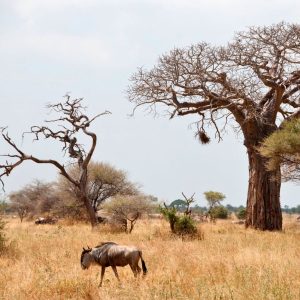
Tarangire rewards those who slow down and engage with it on multiple levels. Walking safaris, led by expert guides, open up a different relationship with the landscape entirely — tracks in the dust, dung beetles at work, the extraordinary architecture of the termite mounds that rise across the park like rust-red towers. Hot-air balloon rides at dawn offer a completely different perspective, floating over the plains as wildlife moves below in the early morning light.
The park also offers a convenient position within Tanzania’s northern circuit, as it sits comfortably between Arusha and the Ngorongoro Conservation Area. Most itineraries treat it as a beginning — and it’s an excellent one. But Tarangire rewards more time than most itineraries allow. The travellers who stay longest tend to be the ones who understand what they’ve found.
When to go
The dry season, running from June to October, is widely regarded as the peak time for wildlife viewing. As water sources elsewhere evaporate, animals congregate in remarkable concentrations along the river, creating reliable sightings of elephants, buffalo, antelope, and the predators that follow them. The sparse vegetation during these months also improves visibility, making it easier to spot game through the bush, while the cooler mornings and evenings make game drives especially pleasant.
The green season, by contrast, has its own considerable appeal. Short, dramatic rain showers transform the landscape into a lush, vibrant tapestry of deep greens and wildflowers, and newborn animals are a common sight as many species give birth during this time of abundance. Visitor numbers drop significantly, meaning you’ll often have sightings entirely to yourself, and lodges frequently offer lower rates. For birdwatchers, this is the standout period — migratory species arrive in vast numbers, joining the resident birds in full breeding plumage. Photographers, too, find the conditions exceptional, with dramatic skies, soft light filtering through storm clouds, and saturated colours that are hard to match at any other time of year.
The only period that isn’t optimal for a visit is between March and May, at the tail end of the rains. Grasses grow tall enough to conceal all but the largest animals; persistent rainfall can disrupt game drives and turn roads to mud; and much of the wildlife has dispersed across the wider landscape, making sightings considerably harder to come by.
Ready to plan your Tanzania safari?
If you’re planning a Tanzania safari and wondering where to begin — or where to spend more time than you’d originally planned — the answer is the same. Start in Tarangire. Let the elephants set the pace.
Contact
Somak House
Harrovian Business Village
Bessborough Road
Harrow On the Hill
HA1 3EX
Tel: +44 20 8423 3000
Email: info@somak.com
Opening times
| Mon - Fri | : | 9am to 6pm |
| Sat - Sun | : | Closed |