
Kruger National Park turns 100 in 2026
March, 2026
One hundred years ago, three cars drove through a gate in the South African Lowveld and into what would become one of the world’s most extraordinary wild places. A century on, the lions still walk the same riverbeds. The elephants still move at dusk to water. The stars still come out in their millions above the acacia canopy. Some things, mercifully, do not change. Go in 2026 and be part of the story.
A park born from a ‘braai’
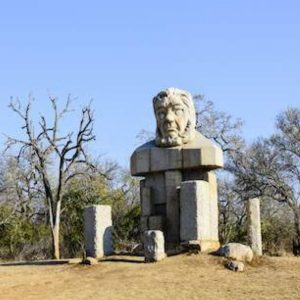
Paul Kruger Monument in the Kruger National Park Photo: Krugerpark.co.za
The story of Kruger begins around a fire, a barbecue which South Africans call a ‘braai’. In 1892, President Paul Kruger attended a gathering at a farm called Rolfontein. Standing around a braai, Kruger spoke publicly for the first time about his ambition to establish a game reserve along the Sabi River. It was an urgent idea. Hunters, ivory traders and frontier farmers had pushed the wildlife of the South African Lowveld to the brink. Kruger recognised that without intervention, the landscape would be unrecognisable within a generation. On 26 March 1898, he proclaimed the Sabie Game Reserve between the Sabie and Crocodile Rivers — one of the first protected areas of its kind in Africa.
It was not yet a national park. In 1902, the reserve came under the care of James Stevenson-Hamilton, a figure who would prove as consequential as Kruger himself. The local Shangaan people called him ‘Skukuza’ — ‘the one who sweeps clean’ — for the way he dismantled poaching networks and patiently rebuilt the reserve’s wildlife populations from almost nothing. Today, the park’s largest rest camp bears his name.
On 31 May 1926, the National Parks Act was passed, and the Kruger National Park was officially established: a unified, protected wilderness stretching nearly 360 kilometres from north to south. The first paying visitors arrived the following year. There were no rest camps, no roads, and visitors needed to be entirely self-sufficient. Only three cars entered that inaugural year. The entry fee was one pound. Today, nearly two million people visit annually.
A kingdom of creatures
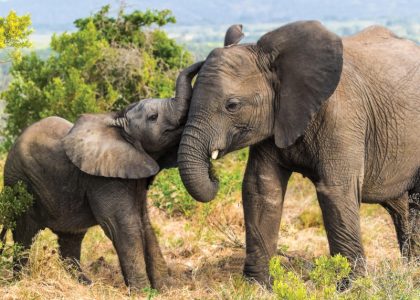
Elephants in the Kruger National Park
A big part of what makes the Kruger National Park such a significant entity is the sheer scale of life it contains. Across nearly two million hectares, the park is home to 336 tree species, 49 fish, 34 amphibians, 114 reptiles, 507 birds, and 147 mammals. It is home to more species of large mammals than any other African game reserve. Today, it is part of Kruger to Canyons Biosphere, an area designated as a protected biosphere reserve that includes two of South Africa’s key tourism sites – the Kruger National Park and the Blyde River Canyon, as well as one of the leading international floral hotspots, the Wolkberg Region.
Big Five
The headline act in the Kruger is the Big Five – lions, leopards, elephants, rhinos and buffalo. The Kruger delivers them in extraordinary numbers. According to South African National Parks (SANParks), the park has an estimated 1,500 lions, 17,000 elephants, 48,000 buffaloes and 1,000 leopards. The southern regions around Skukuza and Lower Sabie are particularly rewarding for first-time visitors. Sabi River draws concentrations of elephant and buffalo during the dry months, and lion sightings are almost routine.
Kruger rewards those who look beyond the famous five. The park shelters one of Africa’s largest remaining wild dog populations, alongside cheetahs, spotted hyenas and caracals, creating predator-prey dynamics that fascinate researchers and visitors in equal measure. Birdwatchers are equally spoilt, with some of the highest concentrations of martial eagles, Kori bustards and southern ground hornbills in South Africa. Serious birders have been known to lose entire days to a single waterhole.
Sabi Secret Seven
Then there are the rarer, quieter treasures. Rangers across the Greater Kruger speak of the Secret Seven: seven mostly nocturnal creatures considered the most challenging animals to find on safari anywhere in Africa. The pangolin curls into an armoured ball at the first sign of danger; the aardvark excavates termite mounds in the dark with its extraordinary sticky tongue; the serval stalks through long grass on improbably long legs. The African wild cat, civet, large-spotted genet and porcupine complete a roll call that seasoned safari-goers quietly obsess over. To see even one is a privilege. To see all seven is the kind of thing people build return trips around.
A century of firsts
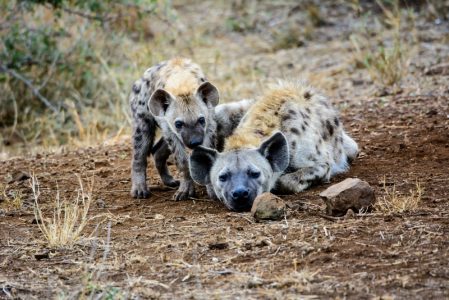
Hyena in the Kruger National Park. Photo: Thompsons Africa
Kruger’s century has been defined by landmark conservation moments that reverberate far beyond South Africa’s borders.
Perhaps the most extraordinary is the white rhino recovery. By 1896, the species was completely extinct in the Lowveld, with fewer than 50 animals surviving in Zululand. Conservationists slowly rebuilt what had been lost through a painstaking reintroduction programme starting in 1961, and today Kruger safeguards the world’s largest white rhino population, one of conservation’s great comebacks.
The park has pioneered new ways of experiencing the wild, too. The Wolhuter Trail, which opened near Malelane in 1978, was among the first guided wilderness walks in Africa, putting visitors directly into the landscape — crouching over elephant tracks, reading spoor in the sand, and understanding the bush as a living system rather than a spectacle. The concept has since spread across the continent.
Then, in 2002, came something remarkable at a political level. Kruger National Park joined with Limpopo National Park in Mozambique and Gonarezhou National Park in Zimbabwe to form the Great Limpopo Transfrontier Park, removing border fences and allowing wildlife to migrate freely between three countries for the first time in over a century. Elephants once again cross the same corridors their ancestors walked long before any boundary was drawn. The following year, Kruger became the first park in Africa to welcome more than one million visitors in a single year — a fitting measure of what a century of protection had built.
Why now matters
The centenary is more than a number. SANParks has woven special experiences, including conservation webinars between March and September 2026, as part of the celebrations and commemorative programming throughout the year. The anniversary brings a palpable energy to the park, felt in the camps, on the drives, and in the stories told by rangers who have dedicated their lives to this place.
For UK travellers, the practicalities are also in your favour. Direct flights to Johannesburg connect easily to Kruger Mpumalanga International Airport, South Africa, which is just two hours ahead of GMT. The South African Rand works strongly in favour of British visitors. The result is exceptional value at every level — from the SANParks rest camps, which are clean, well-run and genuinely authentic, to the private lodge concessions within the Greater Kruger that rival any luxury property in Africa.
Planning your visit: A few essentials
The question most travellers ask is when to go. The dry winter months from May to September are widely considered the finest for game viewing – as vegetation thins and water sources dry up, animals concentrate around remaining waterholes, making the Big Five considerably easier to spot, with August and September particularly rewarding. However, the summer months bring lush, vivid scenery, newborn animals and exceptional birdwatching, and the bush in full leaf has a drama of its own.
The park is large enough to reward different approaches. Self-drive visitors can cover enormous ground over a week, moving between camps and following their own instincts. Guided safaris with private lodges in the Greater Kruger region – particularly in iconic areas such as the Sabi Sand – offer night drives, walking safaris and the kind of expert interpretation that transforms a sighting into a story. Many visitors choose to combine a few nights in a private concession with time in the public park itself, giving a sense of both the accessible and the exclusive.
To avoid disappointment, you must book early, particularly for 2026. The centenary will draw significant interest. Rest camps and private lodges fill quickly during peak season. The experiences that define a Kruger visit – the pre-dawn drive, the morning lion sighting, and the sundowner on a termite mound with a glass of South African wine in hand – deserve not to be rushed.
Book your South African safari with Somak
We’ve been crafting holidays for over 50 years. If you are planning a luxury safari to South Africa, our team at Somak Luxury Travel would be delighted to help you create a journey shaped by decades of first-hand experience.
For unforgettable experiences tailored to you, email us at holidays@somak.co.uk, or contact us at 020 8423 3000 and speak to one of our South Africa specialists.
Contact
Somak House
Harrovian Business Village
Bessborough Road
Harrow On the Hill
HA1 3EX
Tel: +44 20 8423 3000
Email: info@somak.com
Opening times
| Mon - Fri | : | 9am to 6pm |
| Sat - Sun | : | Closed |